
Why Are Traditional Olive Groves Disappearing in Spain?
A Growing Challenge Across the Mediterranean
Spain is the world’s largest producer of olive oil, supplying millions of litres every year to markets across the globe.
Yet behind this success story lies a growing challenge that receives far less attention: the disappearance of traditional olive groves. But this is not happening only in Spain. Italy, Greece, France, Portugal, Morocco… every major olive oil producing country is seeing a similar trend.
Across many olive-producing regions, thousands of olive trees are abandoned every year, when not simply removed. Olive groves that have been cultivated for generations are slowly being left behind, and with them disappear landscapes, local knowledge and agricultural traditions that have shaped the Mediterranean for centuries.
At Olivo Monte Griso, we believe that this is a mistake. We believe that traditional olive production is Lindy: it has survived for thousands of years, and if given a chance, it will survive another thousands. Sure, super-intensive and intensive systems are very productive, but in our opinion, there is a fragility in these systems which should caution the sector about ditching the older groves so lightly.
What Is Traditional Olive Farming?
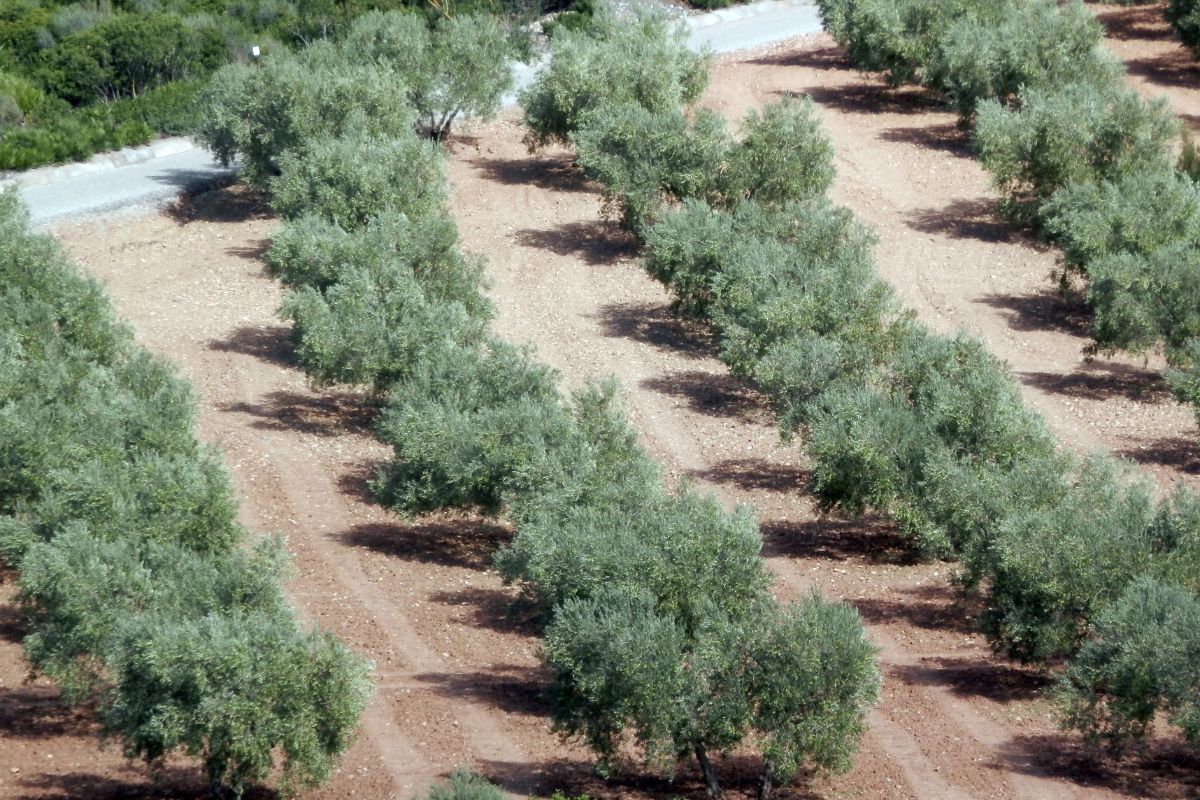
Traditional olive farming is very different from the highly intensive olive cultivation systems that dominate much of modern production.
Traditional groves are characterized by:
- Small family-owned plots
- Low-density tree planting
- Local olive varieties
- Manual harvesting
- Terraced landscapes
- Limited mechanization
In regions such as Aragón, olive trees often grow alongside almond trees, vineyards, cereal crops, forests and natural vegetation, creating the distinctive Mediterranean mosaic landscape.
This farming system has evolved over centuries, adapting to local climates, soils and traditions.
Why Are Traditional Olive Groves Being Abandoned?
The causes are complex and interconnected.
Several factors have made traditional olive farming increasingly difficult to sustain.
Rising Production Costs
Labour, fuel, machinery and agricultural inputs have become significantly more expensive.
Because traditional groves are often located on terraces, slopes or fragmented plots, many tasks still require manual work, making production costs higher than in modern intensive systems.
Labour Shortages
Finding agricultural workers has become increasingly difficult throughout rural Spain.
Many younger generations leave rural areas in search of opportunities elsewhere, reducing the availability of labour needed for pruning, harvesting and field maintenance.
As a result, many olive growers struggle to maintain their groves.
Climate Change and Drought
Water scarcity has become one of the biggest challenges facing Mediterranean agriculture.
Many traditional olive groves depend entirely on rainfall.
In regions such as Teruel, annual rainfall can vary dramatically from year to year, creating uncertainty and reducing productivity during prolonged drought periods.
Extreme weather events, heatwaves and changing seasonal patterns further increase the pressure on traditional farming systems.
Competition from Intensive Production
Modern olive cultivation has radically transformed the industry. Intensive and super-intensive olive plantations can:
- Reduce labour costs
- Increase yields
- Facilitate mechanized harvesting
- Produce larger volumes of olive oil
These production systems have helped increase overall production and promise to make olive oil more accessible worldwide, which is good news. Also good news is that a lot of the olive oil produced from these super-intensive farms follow high quality processes and can be very good (unfortunately traditionally made olive oil doesn’t necessarily mean better quality due to old technology used in the processing and outdated agricultural practices). On the negative side, the dominant varieties used for production of these oils are few (most production comes from arbequina, and other varieties are a minor portion), and regarding the quality of the olive oils produced, they tend to be unstable and lower in polyphenols. Actually, many of them lack the ability to remain Extra Virgin Olive Oil even after 6 months due to the inherent instability of the oil. Also, the hyper-reliance on 1-2 varieties makes all the oils have very similar taste. To make a comparison with the Coffee world, traditional olive oil production would be the world of Arabica coffee, whereas super-intensive olive oil would be Robusta.
Competing on volume alone is no longer possible for many traditional farms.
What Happens When Olive Groves Are Abandoned?
The consequences extend far beyond olive oil production.
Traditional olive groves provide environmental, cultural and social benefits that are difficult to replace.
When fields are abandoned, we lose:
Biodiversity
Traditional agricultural landscapes support a wide variety of plants, insects, birds and wildlife.
The disappearance of these habitats reduces biodiversity throughout rural areas.
Native Olive Varieties
Many traditional regions cultivate local varieties that exist nowhere else.
Without active cultivation, these unique genetic resources risk disappearing forever.
In Aragón, varieties such as Empeltre and the rare Royal de Alloza represent part of the region’s agricultural identity.
Cultural Heritage
Traditional olive farming carries centuries of accumulated knowledge.
Pruning techniques, harvesting methods and field management practices have been passed down through generations.
Once abandoned, much of this knowledge is lost.
Rural Communities
Agriculture remains an important source of economic activity in many rural regions.
When traditional farming becomes unviable, population decline often accelerates, creating additional social and economic challenges.
Why Traditional Olive Groves Matter
Traditional olive groves are more than agricultural fields.
They are living landscapes.
They preserve:
- Mediterranean heritage
- Rural employment
- Local traditions
- Agricultural diversity
- Historical landscapes
- Sustainable land management practices
In many cases, these groves have existed for hundreds of years and continue to shape the identity of entire regions.
The Role of Premium Extra Virgin Olive Oil
If traditional olive farming is to survive, it must become economically sustainable.
At Olivo Monte Griso, we believe one of the most effective solutions is focusing on quality rather than quantity.
Premium Extra Virgin Olive Oil creates value by emphasizing:
- Exceptional quality
- Native olive varieties
- Transparency
- Traceability
- Traditional cultivation
- Distinctive flavour profiles
Rather than competing with industrial production, traditional farms can differentiate themselves through authenticity and excellence.
A Different Approach to Sustainability
Sustainability is often discussed in environmental terms, but true sustainability requires balancing three dimensions:
Environmental Sustainability
Protecting soil, biodiversity and natural resources.
Social Sustainability
Supporting rural communities and preserving agricultural traditions.
Economic Sustainability
Ensuring farmers can continue caring for their land for future generations.
Without economic viability, even the most environmentally responsible farming systems cannot survive.
Preserving the Future of Mediterranean Olive Farming
The future of traditional olive groves depends on creating value for the people who maintain them.
Consumers play an important role in this process.
Choosing premium olive oils produced from traditional groves helps support:
- Family farms
- Rural communities
- Native olive varieties
- Sustainable agriculture
- Mediterranean cultural heritage
Every bottle represents much more than olive oil.
It represents a landscape, a history and a commitment to preserving something that cannot easily be replaced.
The Commitment of Olivo Monte Griso
At Olivo Monte Griso, we manage family olive groves in Teruel, Aragón, with the conviction that traditional olive cultivation remains one of the Mediterranean’s greatest treasures.
Through careful field management, premium extra virgin olive oil production and complete transparency, we aim to contribute to the long-term sustainability of traditional olive farming.
Our goal is simple:
To preserve the land, honour the work of previous generations and share the unique character of Aragón with the world.
Discover Traditional Olive Oil from Aragón
Traditional olive farming is not only about producing olive oil.
It is about protecting landscapes, preserving biodiversity and creating a future where rural communities continue to thrive.
We invite you to discover the unique character of premium extra virgin olive oil produced from traditional olive groves in Teruel, Aragón.
Because every olive tree has a story worth preserving.